Garage Door Service for El Mirage, Serving from Phoenix
El Mirage sits 14 miles from our Phoenix base, so we bundle calls in the northwest valley. Here's how booking, DIY limits, and costs actually work for this area's mostly-2000s doors.
We run out of Phoenix, and El Mirage sits about 14 miles out, so a call here rarely rides alone on the truck. When you book, we're usually stacking your job against other stops in the northwest part of the service area rather than sending a truck out for one door. That's good for you in one way: if we've got a job nearby, we can often slide you into the same run instead of quoting a longer wait. It also means we ask more up front than a shop with a counter down the street would. Tell us the make of your opener, whether the spring is torsion or extension, and if the door is binding on one side or won't move at all. That lets us load the right spring size and the right length of track before we leave, instead of guessing and driving back.
We don't keep a branch or a drop box in El Mirage. Every visit starts as a trip from Phoenix, so the more accurate your description of the problem, the less that drive costs you in wasted time. If you can send a photo of the broken part or the opener's model plate before we roll, do it.
The DIY Question
Most of the housing stock through El Mirage went up in the 2000s, with the area's own median landing around 2004. That means openers on these doors are mostly chain or belt drive units from the early screw-drive-to-belt transition years, with photo-eye safety sensors that are usually original to the house. If your sensors are misaligned or dirty, that's a five-minute fix you can do yourself: wipe the lenses, check the little LED lights, nudge the bracket until they line up.
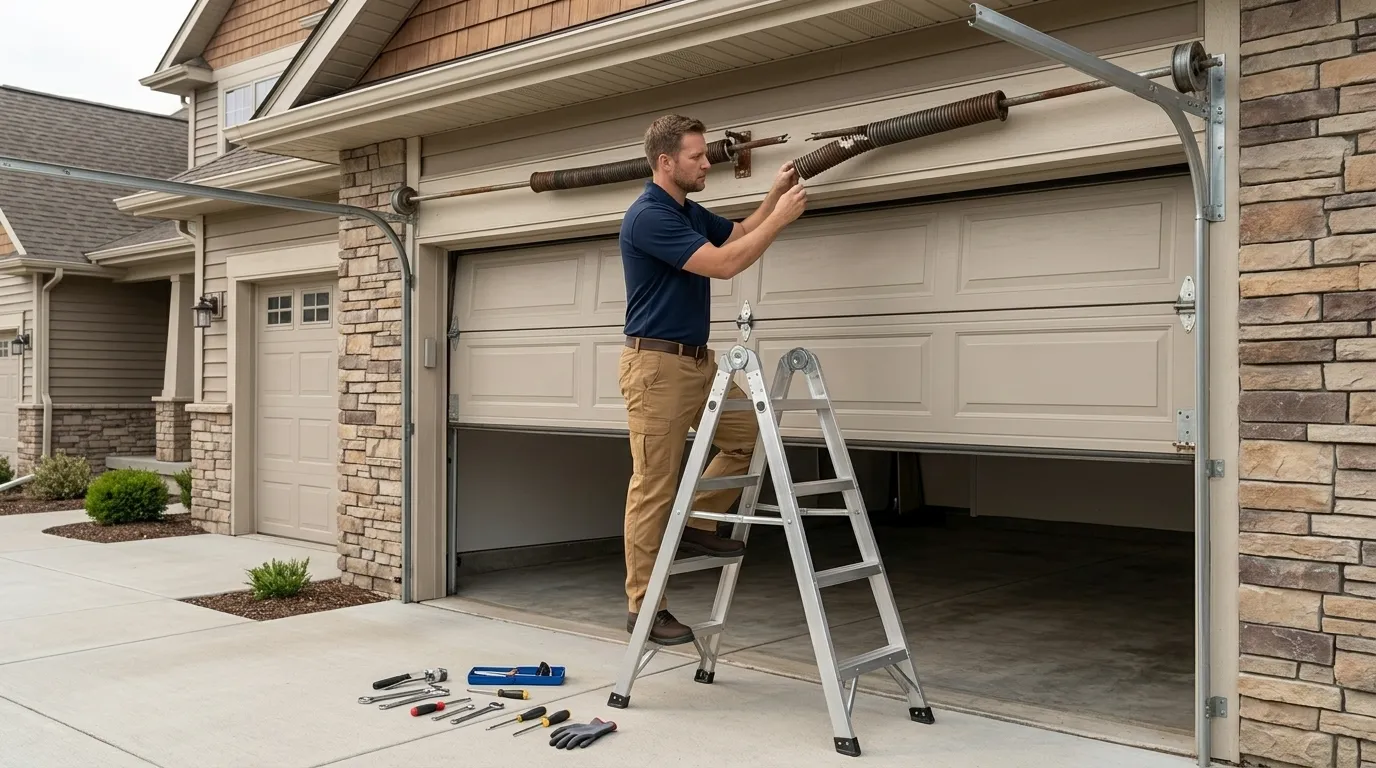
What you shouldn't touch is the torsion spring. On a door this age, the spring is wound to a specific tension for a specific door weight, and it's under enough load to break a hand or worse if the winding bars slip. We also wouldn't recommend re-tensioning cables yourself, or trying to diagnose a dead opener board without pulling the cover, since a board swap on a 2000s-era unit sometimes means matching a specific logic board rather than a universal part. If the door won't budge and the opener motor hums, stop there and call rather than force it.
What It Costs
We don't have a published price sheet for El Mirage calls specifically, and we're not going to quote a number here that we can't back up. What we can tell you is what drives the number when we do quote: the part itself, the length of the drive from Phoenix, and whether the job is a single fix or turns into two once we're inside the door.
One honest limitation: because every job here starts as a 14-mile trip, a small first-time diagnostic call costs more than the same call would if we had a depot in town. We try to make that worth it by handling everything we find in one visit rather than scheduling a second trip for a part we could have carried the first time. If a repair on an older section of the door is going to run close to the cost of a new panel, we'll say so instead of patching something that's going to fail again in a year.
What You Are Seeing
El Mirage's houses are younger than a lot of what we see closer to the Phoenix core. Housing across this side of the service area mostly dates from 1979 to 2007, with a median build year around 2001, and El Mirage itself skews to the newer end of that band, closer to 2004. That means fewer of the old one-piece doors and side-mounted torsion setups you'll find in older neighborhoods, and more sectional steel doors on standard torsion springs with a garage-mounted opener.
The fault we see most in this housing stock isn't age of the door, it's the heat. This is a severe-heat climate band, and the repeated summer expansion and contraction on steel tracks and nylon rollers wears out rollers and bends track brackets faster than in a mild climate. Households through this part of the valley run a median income around $74,764, and with roughly 40,000 owner-occupied houses across the service area, a lot of these doors are original equipment that's now old enough to be hitting that heat-cycle wear point at the same time.
How it works
From “it’s stuck” to “it’s fixed”
01
Tell us what’s wrong
Describe the symptom - won’t open, loud bang, opener runs but the door won’t move.
02
On-site diagnosis
A technician tests the door under power and by hand and finds what actually failed.
03
Clear, up-front plan
You get the fix that’s needed and what drives the cost - before any work starts.
04
Repaired & tested
The repair is done, the door is set true and tested, and the work area left clean.
Serving Phoenix, AZ - tell us what your door’s doing and we’ll take it from there.
How long does it take for a truck to reach El Mirage from Phoenix?
We don't quote a fixed response time, since it depends on where the truck is running that day and how the schedule stacks up. What we can tell you is that El Mirage is about 14 miles from our base, so we try to group calls out there rather than run a single truck out for one job whenever we can.
Is my opener a screw drive or a belt drive?
Most houses in this area were built in the 2000s, which lines up with the shift from screw-drive to belt and chain openers becoming standard. Check the rail above the door - if you see a metal chain or a rubber belt loop, that tells you which one you've got before we arrive.
Why does my roller wear out faster than my neighbor said theirs did in a cooler state?
This area sits in a severe-heat climate band, and repeated summer heat cycling is harder on nylon rollers and steel track brackets than milder weather. It's one of the most common reasons we get called on doors that are otherwise in decent shape for their age.
Ready to get your garage door sorted?
Tell us what it’s doing and where you are in Phoenix - we’ll take it from there.