Spring Repair for Litchfield Park's 2000s-Era Doors
Torsion spring repair for Litchfield Park's 2,867 households, most in homes built around 2001. We travel from Phoenix with springs sized for this era of door.
Litchfield Park is a small town by household count - about 2,867 of them - and that matters for spring repair because it means the housing stock is unusually consistent. Most doors here went up around 2001, part of the same wave of construction that put Litchfield Park's homes squarely in the 1979-2007 build window common across this side of the valley. That's a narrower window than you'll find in older Phoenix neighborhoods, and it means fewer spring sizes and hardware types to sort through on a call, but it doesn't mean fewer failures.
The failures come from heat, not age of construction. This area sits in a severe-heat climate band, and torsion springs live on the wall above the door, baking through summer after summer. The galvanized coating that's supposed to resist corrosion breaks down faster under that kind of heat cycling, and the steel fatigues from expansion and contraction even without a drop of rain touching it. A spring rated for a certain number of cycles doesn't care how many years it's been - it cares how many times it's been wound and unwound under 115-degree metal.
What You Are Seeing
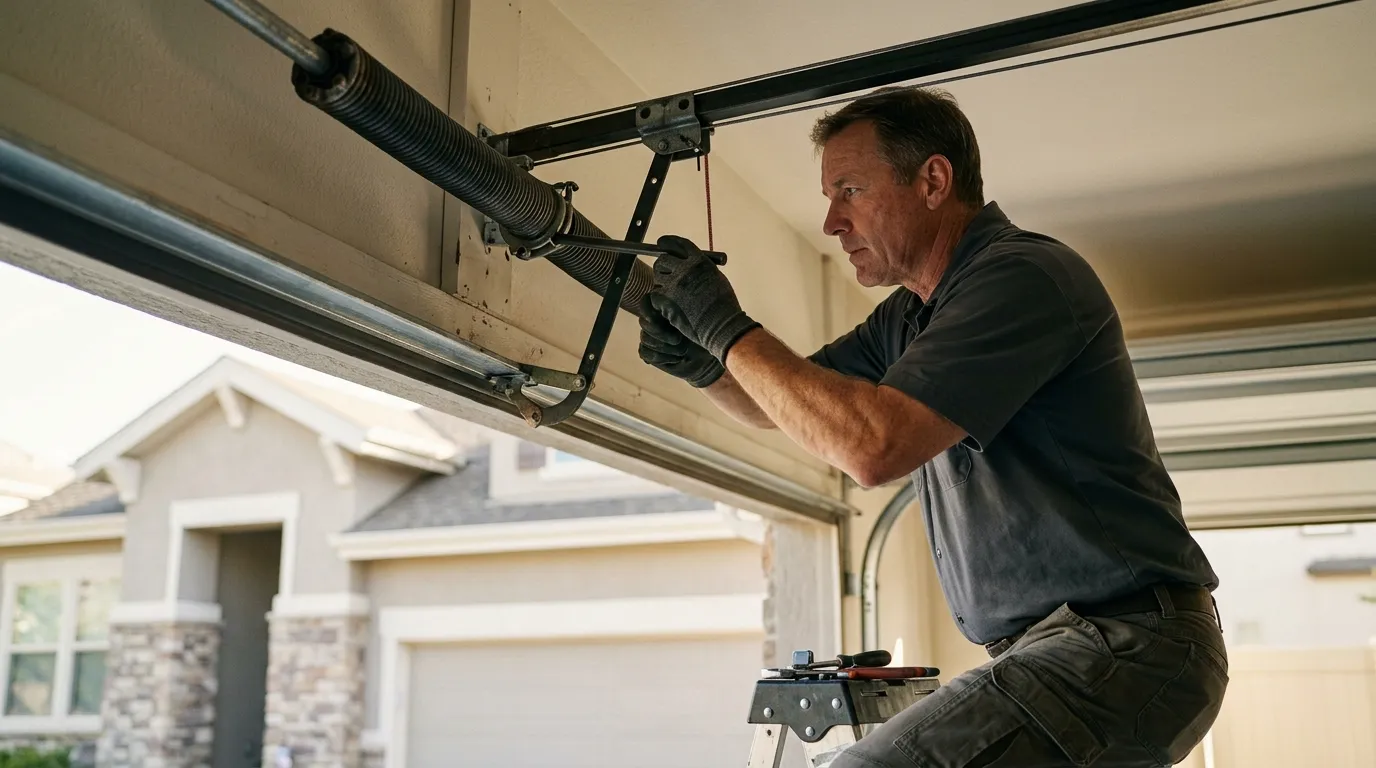
The most common sign is the door that won't budge, or budges an inch and stops, usually with a loud bang from the garage a moment before. That bang is the torsion spring letting go - one side of a two-spring system snapping while the other holds, which is why the door looks crooked or refuses to lift evenly. On a double door, common in this era of build, a single broken spring can leave the whole panel canted at an angle in the track.
A quieter sign is an opener that strains, grinds, or reverses itself halfway up. That's usually a spring that hasn't broken outright but has lost enough tension that the motor is doing a job it was never built to do. Left alone, that strain moves to the opener's gears next, and now you've got two repairs instead of one. If your door has gotten noticeably heavier to lift by hand over the last few weeks, that's the spring telling you before it tells you the hard way.
What Can Go Wrong
A spring snapping isn't usually the whole story. On the way down, a broken torsion spring can whip the cable off its drum, and once a cable's off-track it can bind up the pulley or fray against the drum edge - a second repair riding along with the first. We also see the bottom bracket where the cable attaches take damage when a spring lets go under full tension, especially on heavier double doors common in the 2001-era construction typical of Litchfield Park homes.
The honest limitation: if the spring that failed is an older extension-style spring rather than torsion - more common on doors that predate this town's main building wave - or if it's an odd size from a builder that isn't stocked anywhere nearby, we may need to order it rather than fix it same-visit. That's rare here given how uniform the housing stock is, but it happens, and we'd rather tell you upfront than have you wait on a truck that shows up without the part.
What Is on the Truck
Because Litchfield Park's doors cluster so tightly around 2001-era construction, the torsion springs that fail here are, in most cases, sizes we already carry - wound for the double-door openings standard to that build period, not the narrower single-door hardware you'd find in older stock. We carry matched pairs, since replacing only the broken spring and leaving its worn partner in place is how you end up back on the phone in six months.
We also carry standard cable drums, end bearings, and bottom brackets, since those are the parts a snapping spring most often damages on its way down. What we don't keep on the truck is anything specialty - older extension springs, obsolete builder-specific torsion bar sizes - since those aren't common in a town built mostly in one narrow window. We travel out from Phoenix for these calls, so we load the truck based on what the housing era tells us to expect before we ever leave. For general repair beyond springs, see our Litchfield Park garage door repair page; for the broader service-area rundown on this repair, there's also the Phoenix spring repair page.
How it works
From “it’s stuck” to “it’s fixed”
01
Tell us what’s wrong
Describe the symptom - won’t open, loud bang, opener runs but the door won’t move.
02
On-site diagnosis
A technician tests the door under power and by hand and finds what actually failed.
03
Clear, up-front plan
You get the fix that’s needed and what drives the cost - before any work starts.
04
Repaired & tested
The repair is done, the door is set true and tested, and the work area left clean.
Serving Phoenix, AZ - tell us what your door’s doing and we’ll take it from there.
Torsion springs fail on a cycle count, not a calendar. In this severe-heat climate, the metal fatigues faster from expansion and contraction than from age alone, so a spring can look fine one day and let go the next. The warning signs - a heavier door, a straining opener - are usually there for weeks before the actual snap.
Do you carry the right spring size for my door on the truck?
Most Litchfield Park homes were built around 2001, and the double-door torsion springs that go with that era of construction are ones we stock. If your door is an older extension-spring setup or a builder-specific odd size, we may need to order the part rather than fix it on the same visit.
Is it cheaper to replace one spring or both?
We replace both springs on a two-spring system even when only one broke, because the surviving spring is usually close behind on cycle life. Fixing just the broken one often means a second failure and a second call within months.
Can I drive the garage door with a broken spring?
No. Without the spring's counterbalance, the opener is lifting the full weight of the door on its own, which strains the gears and can burn out the motor. Treat a broken spring as a parked door until it's fixed.
Ready to get your garage door sorted?
Tell us what it’s doing and where you are in Phoenix - we’ll take it from there.